April 22, 2026 | 6:00 PM | Chehalem Cultural Center, Newberg
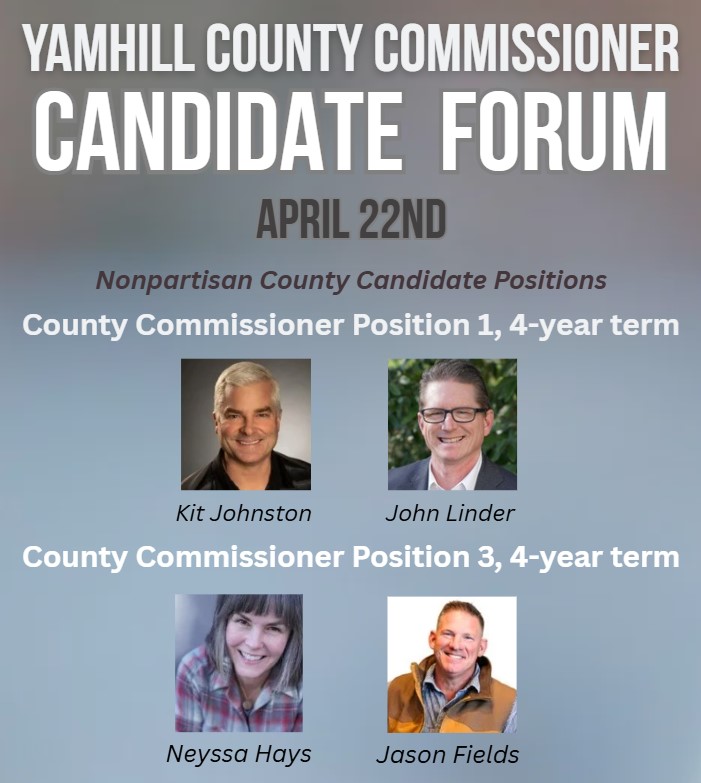
Meet the Candidates: Q&A
Kit Johnston
1. Tell us a little about yourself and what experiences have prepared you to serve as a County Commissioner.
I am a 30-year Yamhill County farmer, a business owner, and a lifelong Oregonian. I am truly invested in this county, and I want it to be a place where businesses and families can thrive. My experiences as a farmer have given me extensive knowledge of land use laws and our county’s $418 million agricultural economy. As a business owner, I am personally invested in making sure Yamhill County has the infrastructure needed for smart economic growth that encourages businesses to come here, stay here, and provide opportunities for high-wage careers. I am a huge advocate for CTE, FFA, and 4-H programs that foster leadership skills and a strong work ethic for our future generation.
For the past three years, I have served as Yamhill County Commissioner. I have encouraged open communication with the community through monthly “Chat with the Chair” meetings after daytime working hours. I have leveraged my own equipment and resources to help our parks and our fairgrounds. I added cities and Chambers of Commerce into the liaison duties for commissioners in order to improve communication and foster relationships that can help drive programs, planning, and economic development across the region.
I also serve as a board member with multiple regional groups, such as:
● Willamette Workforce Partnership: Supports local workforce programs in the region.
● Regional Yamhill County Water Solutions Project group (McMinnville, Dundee, Dayton, Lafayette, Amity, Carlton, and Yamhill): This group was recently awarded a grant applied for by MWVCOG to create a Master Plan that will guide our region’s water supply, treatment, and distribution systems.
● MWACT: Regionally, we are discussing three major transportation projects that will go before the Oregon Transportation Committee as recommendations for the new ODOT CIP. This will set the 10-year outlook for transportation projects in our
region, including the Newberg-Dundee Bypass (Yamhill County), I-5 Brooks Interchange (Marion County), and HWY 22 and 51 (Polk County).
● Parkway Committee: The Parkway Committee’s focus for the last 36-plus years is the development of the Newberg-Dundee Bypass. Most recently, the Parkway Committee went to D.C. to advocate for $410,000,000 in federal funding to complete the bypass. Because of the visit, we anticipate an on-site visit from the US Department of Transportation to look at the progress and our needs for completion.
● Board Member with MWVCOG: As a member of the Mid-Willamette Valley Council of Governments, I am committed to making sure that COG remains sustainable for our cities that require GSI, planning, building inspection, attorney, and grant writing services, just to name a few.
● Member of AOCC (Association of O&C Counties): Most recently, AOCC has engaged in the revision process of the Resource Management Plan to expand the sustainable harvest acreage on BLM lands within the State of Oregon. With more harvest acreage on a more sustainable schedule, the program will begin to lessen the intensity of our wildfires in the future.
2. Candidates often talk about representing all voices in the community. What would you do to bring people together and ensure a wide range of viewpoints are heard in county decision-making?
I meet on a weekly basis with constituents from around the county. Whether at a city council meeting, at a Chamber Greeters, at my monthly “Chat with the Chair,” or for a one-on-one meeting, I make myself fully available to discuss county business with anyone who has questions or concerns. Commissioners are elected on a non-partisan basis, and I take that very seriously. I do not publicly engage in partisan politics, which could alienate a portion of our population in Yamhill County. The job of a county commissioner is public safety, public health, land use and zoning, smart economic growth, infrastructure, and overall livability for families.
I have worked hard over the last three years to prove my commitment to all Yamhill County citizens by remaining focused on essential services and the core job of a commissioner. I have ensured that county boards and committees have voices that represent more than one viewpoint, and I am proud to have earned bipartisan endorsements from across the county. There are so many things that we can all agree on and support together to keep our county a place we all love to call home.
3. What do you see as the biggest challenge facing Yamhill County over the next five years?
Funding for transportation projects. We must make our roads safer for families and more efficient for businesses. We must secure the funding needed to complete the Newberg-Dundee Bypass and fi x some of the most dangerous intersections in the state, the McDougal interchange and Hwy 18/Lafayette Hwy. With budget shortfalls at the state level, we must continue to advocate for our rural road improvement projects at the federal level. Families across Yamhill County can all agree that we should not lose one more life at these intersections.
Affordable housing. We need to think creatively about affordable housing options for families. People need to be able to live in the communities where they work and even where they grew up. This saves time and money, placing less strain on families, and it allows businesses to retain employees. As a farmer and business owner, I have hands-on experience creating workforce housing and understand how important it is to retain good talent. To date, I have six separate housing units that house 10 of my own employees, who have been employed with me for over 20 years.
As a commissioner, I have amended our county ordinance to allow for ADUs (Accessory Dwelling Units) in our rural residential areas, which allows for ADU development on over 3,000 qualified lots in rural Yamhill County. I am also advocating at the state level to have ADUs as an outright permitted use in EFU (Exclusive Farm Use) zones. ADUs on EFU land allow for generational housing options for families to stay together right here
in Yamhill County, and it allows for some of our top economic drivers to retain the workforce needed to keep our county at the forefront of the agricultural industry.
4. How should the County approach long-term planning for infrastructure such as roads, water, and emergency services?
We must have strong relationships across our cities and with our local State Representatives to continue advocating for our share of tax dollars. There is pressure from the state to change our gas tax allocations—this is what’s called the 50/30/20 split. This means 50% of gas tax revenue stays with the state for state roads, 30% comes to the county, and 20% goes to city roads. We need to continue to lead the conversation to maintain or increase our share of that revenue.
We must continue the progress with the Regional Yamhill County Water Solutions Project group (McMinnville, Dundee, Dayton, Lafayette, Amity, Carlton, and Yamhill). This group was recently awarded a grant applied for by MWVCOG to create a Master Plan that will guide our region’s water supply, treatment, and distribution systems. I will continue to be engaged with the conversation that leads to productive outcomes for all infrastructure projects in our region.
We must invest in a new fairgrounds. This is not just for the oldest fair in Oregon (fun fact: originally located in Lafayette) or to have a place for businesses and community members to hold events. A larger fairgrounds will act as our emergency evacuation site in the event of a disaster. This is not presumptive; it is real life. We have experienced this need during the 2020 wildfires where our neighbors were in need, and our fairgrounds served as a place of safety and security for people and animals, not just in Yamhill County, but also our neighboring counties and cities in our region.
John Linder
1. Tell us a little about yourself and what experiences have prepared you to serve as a County Commissioner?
I trained as a CPA and have been involved in investing and business consulting my entire adult life. This means I understand numbers, systems, and – most importantly – accountability. Over the course of my career advising businesses and public boards, I have developed the ability to frame complex issues clearly, establish measurable goals, and insist on systems that track progress and results. True accountability requires three things: clearly defining intended outcomes, establishing policies that allow those outcomes to be measured, and regularly evaluating progress. I will impose this management discipline as a county commissioner in overseeing programs and budgets.
I have served on the McMinnville School Board Budget Advisory Committee for five years. This experience has prepared me well for managing a large and complex budget for a public entity, with a budget roughly equivalent to that of the county. It has also taught me to question until I understand to my satisfaction.
I am a curious person, and read widely. I believe that the county can improve the way it administrates services and infrastructure for its citizens. I will seek to bring additional dollars home to the county and also to use all dollars that the county accesses efficiently.
2. Candidates often talk about representing all voices in the community. what would you do to bring people together and ensure a wide range of viewpoints are heard in county decision-making?
I will seek to represent all voices in our community. This starts with not coming to the table with a predetermined viewpoint from which I cannot be swayed. The Board of Commissioners has citizen advisory committee in order to collect community input, but also to do the hard work of considering the needs of the community. I will not stack advisory committees with yes men, friends and family. Rubber-stamp committees are not worth the time of committee members, and do nothing to represent our community broadly.
I will seek to collaborate with our partners in other levels of government (city government, state government, federal government), as well as business and not-for-profits that operate in our county. Collaboration is the superpower of a county commissioner. I will not have a go it alone mentality. Collaboration and coordination mean more efficient use of resource and more resources for the residents of the county.
3. What is the biggest challenge facing Yamhill county over the next 5 years?
The biggest challenge facing the county over the next five years is the cost of living. Housing is expensive and shows little sign of peaking. As a commissioner, I view my responsibility as smoothing the way as much as i can for housing development and retaining and growing good paying jobs in the county. This means expanding the industries that are flourishing in the county currently (manufacturing, tourism, farming) and coordinating and seeking collaboration amongst these industries so it is not a zero-sum game.
If we don’t encourage and achieve economic growth while keeping a lid on the cost of living, the gulf between those who are doing well and those left behind will continue to expand. This is not good for the county. We must do better in including all of our residents in the prosperity of the county, and this mean collaboration and coordination to make choices that allow for access to healthcare, childcare, public lands and parks, while maintaining public safety.
4. How should the county approach long-term planning for infrastructure, roads, water, and emergency services?
Long-term planning for infrastructure, roads, water, and emergency services should begin with a clear evaluation of our county’s current and future needs. Across Oregon, counties collectively manage over 30,000 miles of roads, and many of those are aging faster than they’re being repaired. Deferred maintenance only drives up costs later, so prioritizing projects that protect public safety and support economic vitality is essential.
In many ways, this is no different than running a successful business. You have to invest in your core assets, plan for growth, and make disciplined decisions about where resources will have the greatest long-term return. Ignoring maintenance or failing to plan ahead only leads to higher costs and fewer options down the road.
From there, we need to pursue funding in a fiscally responsible way. Federal and state grants can cover 60–80% of major infrastructure project costs, but they are highly competitive. That means building the internal capacity and partnerships needed to secure those dollars. Investing in strong grant writing and strategic planning is a smart way to bring outside funding into our county and reduce the burden on local taxpayers.
At the same time, we have to be honest about the long-term cost of maintaining what we build. Road maintenance in Oregon can exceed $25,000 per mile annually depending on conditions, and emergency services face rising costs for equipment, training, and personnel. These are ongoing operational commitments, not one-time expenses—just like in a business, you don’t expand unless you can sustain operations.
We also know that traditional revenue sources are changing. Gas tax revenues, which have historically funded road maintenance, are projected to decline as vehicles become more fuel-efficient and electric vehicles become more common. That means we need to start having realistic, transparent conversations now about how to responsibly fund these critical services in the future.
Ultimately, good planning requires accountability and community input. We need to align our priorities with what residents value and are willing to support. That means setting clear expectations, making data-driven decisions, and ensuring every investment delivers real value. Just like a well-run business, success comes from disciplined planning, responsible investment, and a clear understanding of both costs and outcomes—because wishful thinking isn’t a plan.
Neyssa Hays
1. Tell us a little about yourself and what experiences have prepared you to serve as a County Commissioner.
I’m a co-founder and director of a nonprofit outdoor science education program, where I’ve spent years building programs, managing budgets, and working directly with partners and families across the county. I also serve as Chair of the Yamhill County Parks Advisory Board, where for the past ten years I’ve been involved in long-term planning, public engagement, and navigating complex land-use conversations, often involving widely differing perspectives.
My background includes financial management, grant administration, and organizational leadership, including building budgets, setting priorities, and ensuring accountability. Earlier in my career, I worked in operations and supervision roles where safety, efficiency, and clear decision-making were critical.
I also worked in a plaintiff’s law firm handling personal injury and complex civil cases. In that role, I managed case files, tracked deadlines, and communicated directly with clients, legal staff, judges, and opposing counsel. I was also responsible for evaluating incoming cases and supporting attorneys in preparing for trial. That experience strengthened my understanding of how systems and institutions affect people in real and often high-stakes situations, and reinforced the importance of accuracy, accountability, and follow-through.
Through this work, and through ongoing conversations with city managers, public works staff, and emergency response professionals, I’ve developed a strong understanding of how county decisions impact infrastructure, public safety, and economic development.
Throughout my adult life, I’ve built strong working relationships across sectors, and I’m continuing to meet with department leaders and community partners to deepen that understanding and ensure I’m prepared to make informed decisions from day one.
2. Candidates often talk about representing all voices in the community. What would you do to bring people together and ensure a wide range of viewpoints are heard in county decision-making?
For me, this starts with showing up early and consistently — not just when there’s a conflict.
Good leadership means actively reaching out to people who aren’t always in the room: rural residents, working families, small business owners, and those who may feel disconnected from government. It also means creating environments where people feel heard and respected, even when there is disagreement.
Structurally, I would ensure that county advisory boards are well-seated with individuals who bring a range of experiences and relevant expertise, rather than being dominated by a single sector. I would also work to ensure that the recommendations of advisory boards and department directors are more meaningfully incorporated into decision-making.
In my conversations with local leaders and service providers, I’ve consistently heard that people want to be part of the process earlier — not after decisions are already taking shape. I would support more proactive, accessible public engagement so that concerns can be addressed before they become conflicts.
My approach is to listen carefully, ask good questions, and use those insights to work toward practical solutions. Even when perspectives differ, there is often shared ground — and it’s the Commissioner’s role to help bring that forward.
3. What do you see as the biggest challenge facing Yamhill County over the next five years?
One of the biggest challenges facing Yamhill County is managing growth in a way that supports both economic vitality and long-term livability, without sacrificing the things that make this place special.
In my conversations with business leaders, city managers, and emergency service providers, I consistently hear concerns about infrastructure capacity, housing availability, and the ability of public services to keep pace with growth. Increased commuting is putting pressure on rural roads that were never designed for that level of traffic, workforce housing shortages are affecting both residents and employers, and a lack of available space for businesses to expand is creating additional strain on our local economy.
At the same time, we need to protect the agricultural lands and natural resources that are foundational to our economy and identity.
These challenges are interconnected. Growth, infrastructure, housing, and economic opportunity are not separate issues — and without coordinated long-term planning, we risk falling behind in ways that affect both residents and businesses.
The goal is not to limit growth, but to guide it in a way that is predictable, sustainable, and supported by the systems people rely on.
4. How should the County approach long-term planning for infrastructure such as roads, water, and emergency services?
Long-term infrastructure planning needs to be coordinated, data-driven, and grounded in what our local professionals are experiencing on the ground. From conversations with city managers, county public works staff, and emergency response professionals, a few priorities are clear.
First, we need to prioritize maintaining and upgrading existing infrastructure. The County is already investing approximately $1.5 to $1.8 million annually in road maintenance and working within a long-term pavement management cycle. At the same time, cities are spending significant portions of their budgets contracting out road work because they lack the capacity to do it in-house. There may be opportunities for more coordinated or shared approaches, but there are also real structural challenges, including staffing capacity, procurement requirements, and the complexity of intergovernmental agreements.
I’ve also heard consistently that many of the challenges we’re facing today stem from decisions made without enough long-term coordination. As a result, we often find ourselves reacting to issues rather than planning ahead. Strengthening long-range planning and aligning it across departments and jurisdictions will help us be more proactive, reduce costs over time, and avoid repeating those patterns.
Second, coordination across jurisdictions needs to improve. Cities, the County, and service districts are often planning interconnected systems separately, leading to gaps between growth, infrastructure capacity, and service delivery.
Third, emergency services are under increasing strain. We are seeing rising call volumes tied to growth and behavioral health needs, staffing and coverage challenges in rural areas, and financial instability in EMS systems, where ambulance services often operate at a significant loss.
Fourth, we should be thinking strategically about long-term infrastructure corridors. Preserving abandoned rail lines as future utility corridors creates opportunities for water, electricity, and broadband infrastructure, while also allowing for non-motorized transportation options.
Fifth, we need to be more intentional about how we manage county-owned assets. In some cases, buildings have been allowed to deteriorate to the point where the only option is to sell them. Selling assets may provide a short-term financial fix, but it does not solve long-term challenges — and once those assets are gone, they are difficult or impossible to replace. We should be exploring strategies such as redevelopment partnerships or build-to-suit lease agreements that allow us to maintain long-term value while meeting current needs.
Finally, the County has an important role as a convener. Strengthening collaboration, aligning long-term planning, and pursuing funding strategically can improve outcomes without increasing costs.
At its core, infrastructure planning is about reliability. Residents and businesses need to know that roads are safe, systems are dependable, and emergency services will respond when needed.
Jason Fields
1. Tell us about yourself and what experiences have prepared you to serve as a County Commissioner.
I am a small business owner and have successfully operated my own company for over 13 years, manufacturing custom Volkswagen parts. That background is where my “roll up your sleeves and solve the problem” mindset comes from—something I carry into public service every day. The Volkswagen logo you see in my campaign reflects that hands-on approach: building, fixing, and finding practical solutions that last.
I also bring public service experience through five years on the Yamhill County Budget Committee, where I’ve helped evaluate priorities, protect reserves, and understand the long-term financial challenges facing the county. As an elected director on the Chehalem Park & Recreation District (CPRD) board, I’ve worked on complex land use issues and focused on building stronger partnerships between agencies. Throughout my career and service, I’ve worked to bring people together, solve problems, and deliver results.
Growing up, I experienced time in foster care while my parents struggled with mental health and addiction. That shaped my understanding of how important it is to support families in crisis and keep them together whenever possible. It’s why I strongly support the County’s role in addiction treatment programs, supported housing, and job training—because those services can change lives and strengthen our community.
2. How would you bring people together and ensure a wide range of viewpoints are heard?
Bringing people together starts with showing up and listening. Over the past year, I’ve knocked on nearly 10,000 doors across Yamhill County—not just in one area or with one group, but across the entire community. I’m running to represent everyone, and that means hearing a wide range of perspectives. While people may differ on some issues, I’ve found there are many shared concerns—cost of living, economic opportunity, and quality of life.
In my role on CPRD, I’ve worked through difficult and sometimes divisive issues by focusing on solutions. For example, when conflicts arose over park use, I worked to honor commitments while also finding alternative opportunities that meet broader community needs through partnerships with the County, Sheriff’s Office, and private partners. As a commissioner, I will continue to strengthen collaboration with cities, chambers, and local organizations, building on the county’s liaison approach to ensure we stay connected and responsive to all communities.
3. What is the biggest challenge facing Yamhill County over the next five years?
The biggest challenge facing Yamhill County is balancing limited revenue with rising costs. Due to Oregon’s property tax system, revenue growth is constrained, while expenses—especially personnel, materials, and services—continue to increase. That gap puts pressure on the county’s ability to maintain core services. Through my work on the Budget Committee, I’ve seen firsthand how important it is to maintain reserves and make careful, responsible decisions.
I do not believe the solution is to raise taxes. Families and small businesses are already feeling the strain, and we need to be mindful of that. Instead, we should focus on disciplined spending and creative ways to generate new revenue. One idea I’ve proposed is incorporating a year-round amphitheater into a future fairgrounds plan. This would attract visitors, support local businesses, and bring new revenue into the county to help fund services like public safety, parks, and other needs—without placing additional burdens on taxpayers.
4. How should the county approach long-term planning for infrastructure?
Yamhill County should continue its thoughtful, long-term approach to infrastructure planning while staying adaptable to changing needs. The County’s Transportation System Plan is a key tool that guides decisions on roads, transit, and other infrastructure, and it should be regularly reviewed and updated to reflect growth, shifting priorities, and emerging challenges. Our Public Works team does a strong job identifying and prioritizing projects to get the most value from limited resources.
Partnership is also critical. The county must continue working closely with cities, state agencies, and regional partners to support infrastructure needs, including water systems and emergency services. I’ve seen the importance of this coordination through projects and grant support across the county. We should also look at opportunities to strengthen emergency preparedness, including how facilities like the fairgrounds can support response efforts. Planning ahead, investing wisely, and maintaining strong partnerships will ensure we meet the needs of our communities now and in the future.
Your voice matters — be part of the conversation shaping Yamhill County’s future. Hear their perspectives, learn where they stand on the issues that matter most, and be better prepared to cast your vote.
JOIN US AT THE FORUM REGISTER YOUR ATTENDANCE HERE!